




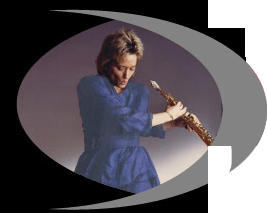






























The Da Camera of Houston sponsored the world premiere of
her work, Chasing Paint at the Museum of Fine Arts in Houston
in March 2002.
 Doris Duke/ Chamber Music America New Works: Creation and Presentation Program 2006
Jane Ira Bloom was awarded a grant to compose and perform a new suite of compositions for her quartet featuring Dawn Clement (piano & keyboards), Mark Helias (bass), and Matt Wilson (drums). The piece entitled "Beyond the Brain" was inspired by Bloom's interest in unconscious thought processes in jazz improvisation. The piece premiered at Tonic, 107 Norfolk St on the Lower East Side in NYC in January 2007 and was then re-performed in March 2007.
 Doris Duke/ Chamber Music America Jazz Composition Award 2001
Jane Ira Bloom is one of twelve
jazz artists chosen to create and a present a new work for
their own ensemble, She has received funding to compose a
suite of compositions for her quartet inspired by the action
paintings of Jackson Pollock. Her quartet features Fred Hersch
(piano), Mark Dresser (bass),and Bobby Previte (drums).
 Jazz
Journalists Awards
Jazz
Journalists Awards
Jane received the Jazz Journalists Association 2006 soprano sax of the year award at the awards event on Monday, June 19 at B.B. King's Blues Club and Grill in New York City
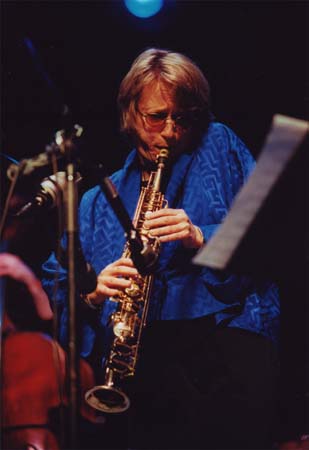
(6083) Janeirabloom = 1984 SQ2. Discovered 1984 Sept. 25 by B. A. Skiff at the Anderson Mesa Station of Lowell Observatory. Named in honor of soprano saxophonist and jazz composer Jane Ira Bloom. Bloom is known for her chromatic, lyrical playing and compositions for orchestra, unusual ensembles, and dance troupes. Her performances with traditional jazz groups appear on several critically acclaimed recordings. As the first musician in the NASA Art Program, she wrote ``Most Distant Galaxy'', and ``Einstein's Red/Blue Universe'', the latter on commission for the American Composers' Orchestra. More details about asterois 6083: The asteroid now named (6083) Janeirabloom was discovered in autumn 1984 on photographs taken with the 13-inch Asteroid discoverers are permitted to suggest names for their numbered objects. Historically these started out with Greek and Roman mythological names as had been given the planets. But the tradition broke down as large numbers of objects were found (too many asteroids, not enough gods!). Although first discovered at Lowell, asteroid (6083) has since been observed in many places around the world. These include observatories in Australia, Germany, and the United States, as well as at a military satellite- tracking facility on the summit of Haleakala, Hawaii. The modern observations were extrapolated back to 1927, and archival measurements found to match the object. This long observational history means (6083) can be located precisely for decades to come. It will next become observable late in 1998 and be found through the succeeding winter near the constellation Cancer. The asteroid is nevertheless a very faint object, peaking in January 1999, for instance, at brightness more than 10,000 times fainter than can be seen by the unaided eye on a dark desert night. The asteroid itself is a typical "main-belt" asteroid, orbiting every 3.35 years at an average distance of a bit more than twice as far from the Sun as Earth. The asteroid's orbit around the Sun is, however, slightly eccentric, like its namesake. There is no specific study of it, but using observed estimates of its brightness, and making some assumptions about its surface composition, we can estimate that Janeirabloom is perhaps 5 kilometers or about 3 miles across. Read the full text of Jane's citation and learn more about Asteroid (6083) Janeirabloom at this link to the Minor Planet Center.
Asteroid Named in honor of Jane Ira Bloom
 The following citation appears in the February 1998 'batch' of "Minor Planet Circulars", produced by the International Astronomical Union's Minor Planet Center, in Cambridge, Massachusetts:
 astrograph (photographic telescope) at Lowell Observatory in Flagstaff, Arizona. (This is the instrument used to discover the planet Pluto in 1930.) After one month's observation it was lost from view, and not picked up again until 1989. These and later measurements were linked via successive orbit calculations as additional observations were obtained. Eventually, in 1994 enough data became available to compute the object's location in the sky quite precisely many years in advance. The asteroid, which had been given the preliminary designation 1984 SQ2 for bookkeeping purposes, was then assigned a permanent number, 6083. At present there are about 8500 such 'numbered' asteroids, plus some tens of thousands whose orbits are known only approximately.
Jane Ira Bloom invited
as Kayden Visiting Artist at Harvard University.
 Saxophonist / composer Jane Ira Bloom was in residence at
Harvard University's Learning From Performers program sponsored
by the Office of the Arts at Harvard. As a Kayden Visiting
Artist Bloom was in residence November- December 2004 lecturing
on improvisation and interdisciplinary collaboration as well
as performing with the Harvard University Jazz Bands. She
was also commissioned to write a new work dedicated to jazz
soprano saxophonist Steve Lacy which she performed in concert
on Dec 11, 2004 at Lowell Hall in Cambridge, MA. Other artists
on the Learning From Performers series have included jazz
pianist Hank Jones, flutist James Galway, and playwright Tony
Cushner..
Saxophonist / composer Jane Ira Bloom was in residence at
Harvard University's Learning From Performers program sponsored
by the Office of the Arts at Harvard. As a Kayden Visiting
Artist Bloom was in residence November- December 2004 lecturing
on improvisation and interdisciplinary collaboration as well
as performing with the Harvard University Jazz Bands. She
was also commissioned to write a new work dedicated to jazz
soprano saxophonist Steve Lacy which she performed in concert
on Dec 11, 2004 at Lowell Hall in Cambridge, MA. Other artists
on the Learning From Performers series have included jazz
pianist Hank Jones, flutist James Galway, and playwright Tony
Cushner..
For more info: http://www.fas.harvard.edu/%7Eofa/